

This paper compares scarcity pricing designs across selected EU countries and their role in supporting system adequacy in power markets with growing renewables, including interactions with capacity mechanisms.
This paper by Luca Lo Schiavo analyzes the fact-finding investigation of the Italian regulatory Authority (ARERA) into economic generation capacity withholding in Italy's day-ahead electricity market, examining its methodology, findings, and the resulting controversy with the generation operator.
This segment from ERRA's 25th Anniversary is a reflective, high-level discussion on how energy regulation has fundamentally changed over the past 25 years, why it has become more complex, and what this means for regulators going forward. It contrasts the early era of liberalization with today’s realities of decarbonization, electrification, geopolitics, digitalization, and renewed state involvement.
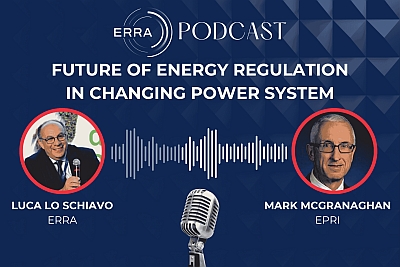
This segment of ERRA's 25th Anniversary Podcast features Luca Lo Schiavo, ERRA's Senior Regulatory Specialist discussing Transformation in Regulating Energy Over the Last 25 Years with Jorge Vasconcelos, Chairman of the New Energy Solutions (NEWES), Portugal.
This paper examines the regulatory shift from net metering to net billing, drawing on comparative experiences from Italy, Kosovo*, and Georgia. It places Georgia’s 2023 reform within this broader European context, emphasising both its alignment with EU principles and the remaining steps needed to fully integrate prosumers into the market.
This inaugural episode of ERRA’s Energy Regulatory Podcast features host Luca Lo Schiavo engaging with Ivan Faucheux, Commissioner at the French Energy Regulatory Commission (CRE), for a detailed discussion on CRE’s recent analysis of Small Modular Reactors (SMRs) and Advanced Modular Reactors (AMRs).
This Eurelectric's report focuses specifically on Flexibility for Distribution Grid Needs, as per the newest proposal of ENTSO-E and EU DSO Entity on the methodology for assessing flexibility needs that ACER approved in August 2025.
Ukraine’s energy sector has rapidly transformed as the war revealed structural weaknesses and prompted urgent regulatory reforms. The regulator, together with the Ministry, introduced a modern regulatory framework for energy storage, recognising flexibility as a vital component of system security rather than a long-term goal. The Energy Storage Facilities Law and subsequent NEURC regulations formalised storage as an independent market participant with full access to wholesale markets, offering investors much-needed legal certainty during a time of significant system stress.
On April 28th, 2025, the whole Iberic Peninsula (Spain and Portugal) experienced its most severe blackout in history. Based on currently available research, it wasn't an excess of renewables that caused the collapse—it was the delay to integrate it properly through a modern regulation.
We use cookies to ensure that we give you the best experience on our website. If you continue to use this site we will assume that you are happy with it.